Dependency Injection was always a tricky concept and hard to understand for me when I started my career.(Well, in fact even in college days this was the chapter that I left on optional.)
Later, after working on .NET web applications and I understood the basics of Dependency Injection, But I still had some gaps. So, when I got a chance to explore more about this concept, I jumped right in and thus sharing my experience via this blog.
.NET Web Applications are based on C# which is in turn based on OOP. So this means classes and objects…..lots of classes and objects. These Classes and Objects depend on one another. With an increase in time the number of classes and objects will increase, causing complexity to increase if not implemented properly. Also with increasing complexity the maintenance will be difficult.
Normally, we will have a interface and a service class that implements that interface a constructor that has this service class as attribute. Like below,
Application Execution wise there’s no big problem with the above code. It will execute fine. But you see here, there’s a tight coupling created. Meaning objects creating another objects on which they depend on. With the increase in the lifetime of an application this kind of hard coupling is gonna increase.
Dependency Injection addresses this issue. DI states that components – objects shouldn’t create objects they depend on, instead they should be passed to them. Thereby reducing the tight coupling, increasing maintainability etc. There are multiple ways to do this.
Constructor Injection
Property/Setter Injection
Method Injection
The most commonly used approach is Constructor Injection, where we pass the dependencies via constructor thereby allowing them to be used anywhere within the class.
Sitecore Default DI is Microsoft DI. So, we need a ServiceConfigurator where we can register the dependencies which can be passed on to the controller.
When we inject a dependency there are ways in which their lifetime can be set.
AddTransient – The services are created each time they’re requested.
AddScoped – The services are created once per client request.
AddSingleton – The services are created for the first time they are requested and then every subsequent request will use the same.
We need to register this Service Configurator via config file like below.
We can also register a service from config directly . We can check the dependency registration – service configurations via,
/sitecore/admin/showservicesconfig.aspx
So it may seem we have done everything required. Let’s give it a spin.
We have done almost everything. Created Interface->Service Class->Controller->Registered the dependencies in Service Configurator->Passed the dependencies via constructor controller. But still we get the above error.
This is because for the controller the dependencies were not getting passed. Which means we still have one action pending. Which is registering the controllers. We need to register every controller that consumes the dependencies.
We can also get the dependencies using Service Locator. If you don’t have the option of passing the dependencies via Constructor Injection then getting the dependencies via Service Locator is the other option.
Regarding Controller registration, instead of doing them individually, thanks to Kam Figy’s code they can be registered all together based on the assembly. FYI
Now, we can register new services that will be developed during the lifetime of the web application in the service configurator and use them in the controller. This improves code maintenance and reduces tight coupling. This also enables us to implement better unit testing. Say we have Rest API related implementation. When we write unit test methods they can’t call actual API. In such cases mock response needs to be used. When can have some config keys where we can decide when to use actual implementation and when mock implementation. And the actual or mock implementation can be passed as a dependency via Service Configurator.
Last week one of my friend asked me whether I have worked on something that kinda allows us to show Sitecore Analytics data like Top 5 Visited pages of a website in a 404 error page…Something like page you searched for is not found…Interested in checking out these top visited pages….(Probably some content with better English)
Although I haven’t worked on such requirement but the idea of displaying some analytics data in a webpage of the website thereby providing a better user experience caught my attention.
So I explored it further and thought I would share about the steps involved.. in this article.
Sitecore has a reporting DB that has details about these data. The reporting database contains aggregated data from the xDB collection database. In Experience Analytics module, were you see the Number of Visits, Top Page Entry/Exit etc are presented based on the data in this DB.
This reporting db has a table Fact_PageViews. Fact table is a data warehousing term used to describe tables that contain measurements and metrics. In a fact table foreign keys allow joins to be made with dimension tables.
After exploring this DB/table for few mins wrote a query that solves our requirement.
So, now all we have to do is create some logic that runs this query when needed and provides the Item IDs. Based on this Item ID, we will be able to get the page details like page name and URL which can be presented in the rendering.
After some browsing I came across Sitecore Report Query.
Sitecore has this Report Query template that allows you to specify the datasource (the DB) and the query that needs to be executed.
So, create an item based on this template and include the necessary values. (Datasource – reporting and our query)
From code prespective,
Create a class that is based on ItemBasedReportingQuery. Make use of the item ID of the report query item we just created and pass them in the constructor (base)
Implement the Execute method and include our logic there. After the query is executed, the results are available in datatable format, from which we can convert them to our custom format.(PageandViewCount).
Create a helper class/method that executes this query.
Finally, based on the item id we can get the item. Based on the item we can get the page name/page url. Create a corresponding rendering and add it to the required page.
There is also another way to execute sitecore query, using the reporting API straight away without using the report query item. But here you need to hard code the query or fetch it from some constants.
In my last article, while concluding I mentioned that we can create lists for male 18-30; 30-40 and 40 & above, use them relevant campaigns. This is the follow up or a sequel kind of article discussing about that use case. I thought just like how we created a logic that checks the contacts gender and adds them to a list, similarly we can retrieve a contacts DOB, calculate their age and add them to the list. (Spoiler – that’s not how we are going to add them to a list in this article)
After I shared that article for comments, I was pointed out that, unlike gender which is a constant throughout the customer engagement, age is not a constant. In varies daily, in fact increases daily. So, we have to run this logic regularly to update the list. Which is probably not a good idea and I was directed to segments and hence this article.
Segments Vs List
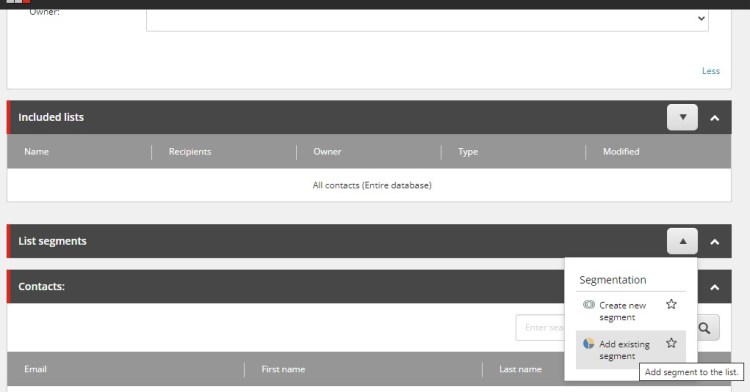
Unlike lists, when we create a segmented list, we can specify ‘Segments’ for that list. Now, List Segment or Segments are just rules. When we specify the ‘Segment’ for a list, only the contacts that satisfy these rules will be added to that list. It means that, when you create a normal Contact List, you can add contacts from sources (Sources can be any other lists or you can add contacts to that list via code or you can add contacts manually or via Marketing Automation etc) but, in segmented list you can specify a rule like ‘when contact gender is male’ or ‘when contact is from a specific city/country’ and sitecore does the remaining part. It will add only the contacts that matches these rules. In a way, lists are static whereas segmented lists are dynamic. When you create a segmented list, the segments mapped to that list are run and then the contacts are added. When you make a change to the rules – segments – the list is updated based on the new conditions.
Enough with the theoretical part, let’s pick a business case and create a segmented list. Let me pick the age based business case itself but with a small change. Instead of seeing it from age perspective, let us create a segmented list base on the date of birth like people born between 1990 to 1995 to explain about segmented list.
Sitecore provides few OOTB rules which we can use to create segments. But this Date of Birth between Min Date and Max Date although is available but wont be visible in the available rules list as it deals with PII Sensitive Data.
(We can create new rule based on the relevant template and configure the values like I mentioned in one of my prev. article, but this rule item has everything we need so in order to save some time I am making use of this rule item and will make necessary changes to suit our requirement)
In order to use this rule,
These rules are grouped under, /sitecore/system/Settings/Rules/Definitions/Elements/XConnect – Contact Personal Details Conditions,
Create a copy of the Where Contact Birth Date Between item under /sitecore/system/Settings/Rules/Definitions/Elements/XConnect – Contact.
Alright in the screenshot, if you notice the type field value in the script section you might see the custom rule mapped.
This is because, sitecore rules is of three types, the one we use in personalization of a page, the next one which is used in Marketing Automation and the final one is the one which we use in Segmented Lists. Although the may seem similar, these rules are quite different from the code perspective. For the segmented lists, these rules must be inherited from IContactSearchQueryFactory and should implement CreateContactSearchQuery() method. This method will be used during the process of adding contacts to the segmented list by sitecore.
Having said that the actual item’s type value doesn’t inherit IContactSearchQueryFactory. PFB screenshot. So, if we use this rule as it is, we will get error.
So, we will create a custom rule class based on this one and make sure that it inherits IContactSearchQueryFactory and write our logic in CreateContactSearchQuery.
The Logic is simple, CreateContactSearchQuery needs to return a lambda expression, so from the contact, we can create an expression, that gets the personal info and uses the date of birth and tests if it passes our conditions.
Okay so you may think now, we can use this rule and create a segment and then a segmented list right? Even I thought so. But, although I didn’t get any error while using this rule, this list was not getting populated with contacts.
After several code changes, trial and errors, I came across an article mentioning that Sitecore Xdb core by default doesn’t index PII sensitive data by default.
Now it made sense, in order for use to use a PII Sensitive field like DOB, we need to set this IndexPIISensitiveData to true and rebuild xDb index.
We need to make this change in {xconnect}\App_Data\jobs\continuous\IndexWorker\App_Data\config\sitecore\SearchIndexer\sc.Xdb.Collection.IndexerSettings.xml
Now, we have to reindex xDb Core. To do this, open CMD and go to {xconnectwebroot}\App_Data\jobs\continuous\IndexWorker and run ‘Sitecore.XconnectSearchIndexer.exe -rr’
Now we have everything in place, we have the date of birth related segmented rule, lets a create a segmented list for all contacts who are male and born between 1990 to 1995.
After clicking Save, the list will be populated with the contacts matching the segment rule – gender male and DOB between 01/01/1990 and 01/01/1995
P.S:
This still doesn’t solve ‘the age of the contact gets updated everyday and the list wont be updated everyday problem.’
But, using this segmented list, before starting any campaign or any marketing automation, we can generate a list based on their date of birth range and use them for that campaign.
We have explored creating a Custom Form Element – Rich Text Field and Creating a Custom Form Field Validator earlier. Ever since I wrote those articles, I always wanted to explore creating a Custom Submit Action. But rather than just writing about how to implement a custom submit action, I thought I will pick some meaningful business case that demands a custom submit action and explore it from a marketing perspective.
Finally, after several months, when I was having a discussion with one of my ex-colleague I came across this business case. I thought, I will explore it and share my experience here.
So…let’s get started.
We will create a custom submit action, that creates a contact and we’ll add the contact to different Sitecore Lists based on their gender. Once this list is populated with corresponding contacts, we can use those list for campaigns using E-Mail Experience Manager or Marketing Automation.
So it’s pretty much straight forward now, in this article, we’ll be
Creating a Simple Form that uses a-> Custom Submit Action, to -> Create Contact based on that user info submitted -> Add the contact to Male Contact List or Female contact List based on the gender value they have specified in the form.
We will be using a simple Sitecore Form, no complex fields. In fact, I created one registration form long back. I will use that for our case.
However, we’ll be using our newly created Custom Submit Action – Create Contact.
Creating a Custom Submit Action:
To create a custom submit, create a class that inherits from SubmitActionBase<string>. This SubmitActionBase is available in Sitecore.ExperienceForms assembly.
This SubmitActionBase has a Execute method which we will be overriding and writing our custom logic there.
This execute method has Sitecore FormSubmitContext as one of the arguments. This FormSubmitContext had fields that provide details about the Submitted Form like the field values, if it has any errors, page in which the form is submitted from etc.
We will be reading the values of the form fields submitted by the user. And assign it to a custom user model.
Based on the field type the way in which we read the field value differs. In our case, we had a radio button/date and a DropDownList.
Once the User object is assigned values, we will pass that to CreateContactandSubscribetoList Helper method that creates contact based on it.
Creating a contact is simple, instantiate an Xconnect Client, create a contact object, set the required facets i.e., Personal Facets, E-Mail/PhoneNumberList facet in our case.
Creating a Sitecore Submit Action Item.
Under /sitecore/system/Settings/Forms/Submit Actions, create a new Submit Action named CreateContact based on Submit Action template(Available in the Insert Options)
In Settings session, Model Type add the class name along with the full namespace.
This custom submit action created will be added to the list of available submit actions in the Forms Editor and we can assign it to our submit button.
Create two Lists:
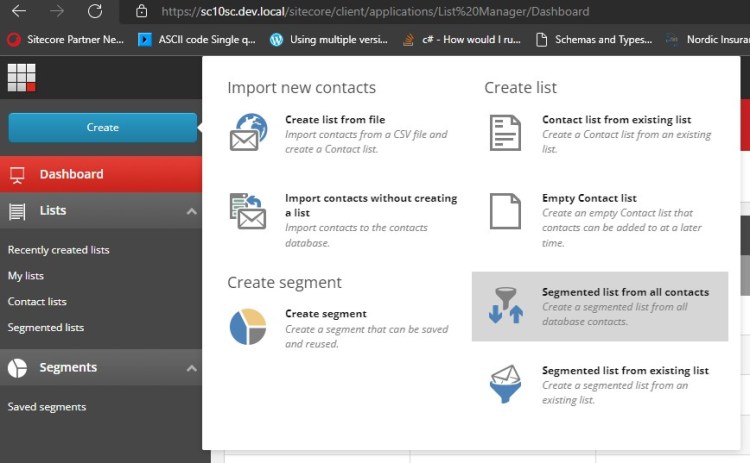
By open List Manager from Launchpad, click Create Empty Contact List. Create two such lists, one for Male and one for Female.
Make a note the IDs of these two lists. We need the List ID to subscribe a contact to that list.
The IDs of these two list can be obtained from Marketing Control Panel. -> /sitecore/system/Marketing Control Panel/Contact Lists/
Add Contact to the List based on the gender:
To add a contact to a list programmatically, we can use ISubscriptionService available in the List Manager API -> Sitecore.ListManagement.Xconnect.Web assembly.
We can add the contact to the list using the Contact ID and List ID.
Add this logic to CreateContactandSubscribetoList helper class.
In a real time scenario, instead of hard coding the list values, we can fetch them from configs or constants.
So, now we have everything in place, let us submit a form and see based on the gender, the contact gets added to the corresponding list.
There we go, the contact got added to the male list. Similarly, the contact’s session details will also be present in Experience Profile as well as we have included the relevant code.
This is sample use case. As you can see, we are obtaining the DOB as well. Similarly, we can create a list of male/female contacts between 18-30; 30-40 and 40 & above. We can create list based on the country if we collect address. And many more such scenarios. This way we can conduct campaigns that are more relevant to the contacts belonging to this list. Will write an article on how we can setup some campaigns based on these lists in the coming days.
The article related to this business case can be found here.
which would open the browser and redirect you to Identity Server Login page for Authentication, Once you enter the User Name/Password your session will be authenticated and you would be able to perform the serialization.
If you were to setup a pipeline that does this serialization, using the same approach is not quite possible. Because, everything needs to be automated to the maximum. In order to tackle such cases, Sitecore provides a Non-Interactive way to login->get authenticated and use that authentication/authorization for further serialization process. The command for sitecore non interactive login is,
It uses two new attributes – Client ID/Client Secret.
The Official Sitecore documentation, provides all the setup details. It is clear and almost has all the required details. But however, in spite following this article, I came across a couple of issues. Thought I will share about those issues and how we can overcome them here, hoping it helps the community.
Client ID/Client Secret:
According to the sitecore documentation, in Sitecore.IdentityServer.DevEx.xml, we should be specifying the client secret/Client ID.
This Client Secret/Client ID is based on ‘IdentityServer4.Configuration.IdentityServerOptions.InputLengthRestrictions‘ property, which doesn’t have any minimum length restrictions but the maximum length for these attributes is set to 100.
So, if your client secret or client id is string of length more than 100 you might get the below error.
App Pool Recycle – Not Just restarting the web app
According to the sitecore documentation, after the changes are done in both these config files, we have to restart these two applications.(CM/Identity Server Web Apps)
But merely, restarting the app didn’t workout for me. I was still facing the “Error while getting client credentials token: invalid_client”
I tried to replicate this issue in a plain vanilla instance and fortunately I was able to replicate this issue in plain vanilla as well. Reached out to Sitecore and mentioned about this issue to them. They recommended to recycle the app pool as well.
So, after making the necessary config changes, it is recommended to recycle the app pool for these two instances as well. Esp. identity server role.
After recycling the app pool, after making a config change, this issue is resolved.
This kinda made me, go through the basics once again. What does restart a web app in IIS do and what an app pool recycle do. Sharing that info below.
App Pool Recycle:
“When you recycle an application pool, IIS will create a new process (keeping the old one) to serve requests. Then it tries to move all requests on the new process. After a timeout the old process will be killed automatically. You usually recycle your application pool to get rid of leaked memory “
I guess this makes sense as to why the issue I faced with the login was fixed after app pool recycle.
App Restart:
"As for restarting a website, it just stops and restarts serving requests for that particular website."
Sitecore from the year it was founded to this day,(From being a Web Content Management System to a Digital Experience Platform) has made several changes to their products, product features and product portfolio.
The Idea of Sitecore:
Sitecore was initially created as a project to automate website creation process (after implementing several websites for clients they wanted to automate it) later, the key people around the project at that time, realized the project has a larger scope and has bigger business potential, a market need for such an exclusive product and decided to tap on that opportunity to create a full fledge CMS Product – Sitecore. From that happening around 1998-2001 to today (2021/2022) – Sitecore gearing up to be a Cloud First – Composable – SaaS offering ,the product and the company has gone through a lot of changes.
If you are new to the Sitecore world, then I would say it’s a good time to get started. Sitecore has released several new products in a very short span – in the last 14-16 months. Thanks to their acquisition strategy. The point is, although the business or functional use of these products are similar to their previous products, these products are new and are getting changed or planned to be altered to fit in the sitecore landscape. This means, these are new products with lots of scope but relatively less players in the market who are well-versed in these products.
I’ve been associated with sitecore development for more than half a decade now and I have watched them update their product/offerings year by year based on market trends, in-dept proprietary studies.
In this article I wanted to share about, where Sitecore wants to position itself in the upcoming years (or at least, my understanding of where sitecore wants to…. ). But, in order to understand that we have to first know where Sitecore was and where Sitecore is now .
So, Let’s get started.
Sitecore Yesterday (Sitecore 6.5 to Sitecore 8) (Content -> Marketing)
I don’t want to start from very early version of Sitecore and bore you. Also, I don’t have much info, related to those early versions of sitecore. Sitecore 6.5 was released around 2011. It was an important release as they made some key upgrades to their Digital Marketing System (DMS) module.
Prior to this phase, Sitecore was much of a web content management system. Of course they were leaders in this segment but still the industry started shifting. This was around 2006 – 2009. With evolution of social media and a shift in Digital Marketing domain, Digital Marketing Modules were the new cool tool to have. But the existing marketing tools which were available in the market had to be integrated with their web application or their CMS. That’s when Sitecore planned to create a unified solution that provides marketing and analytics related module for your websites in single place – the base for Digital Experience Platform.
“Usually when an organization want to expand they start to acquire other companies. But sitecore wasn’t loaded much to make those acquisitions. So they had to work on these modules from scratch.”
In Sitecore 6.x versions esp. 6.5 and 6.6 introduced key features like Marketing and Engagement Automation, Dashboards and Reports, Real time personalization etc. (2008-2012)*
In Sitecore 7.x versions sitecore made key upgrades to analytics and experience related components. In 7.5 sitecore introduced Profile and xDB. Sitecore introduced Contact entities in these versions. Sitecore Contacts allows use to track users and their behaviors during their visits. (2013-2014)*
Customer Engagement Platform was renamed to Sitecore Experience Platform (XP) which is what it is referred to by today, in this period. Along with this change, several other modules were renamed to what we know them by today.
Experience Analytics, Email Experience Manager etc.
Sitecore 8.x brought in a huge set of upgrades to the product. The look and feel was completely redone. The login screen, the Experience Profile and Experience Analytics. The Launchpad Page was brought in this version. Shared/Final Layout; List Manager and segmentation lists; Path Analyzer; Federated Experience Manager; Experience Optimization, tag contents by Profile cards and etc.
Sitecore introduced Experience Accelerator during this period. Sitecore 8 was a milestone release. A big revamp to the product and lot of new generation marketing tools. (2014-2016)*
Rather than me writing about the Importance and the rich features that were provided by version 8, it’s market impact and etc, I thought I would share the Gartner Quadrant for DXP for all these years and end the discussion.
Gartner 2014
Gartner 2015
Gartner 2016
Gartner 2017
Sitecore have always been the Market Leaders in the top 2 spot.
Sitecore at this period 2013-2014 started expanding it’s product portfolio by acquiring commerceserver.net and released Sitecore Commerce Server by 2014. (Acquisition)
Sitecore 9 again had lots of change in the product architecture, several new components were introduced. Sitecore Identity server, Sitecore Xconnect. Prior to Sitecore 9 Web Forms for Marketers was the module that was used by content authors for creating a form on their sitecore website on the fly. In Sitecore 9 for this requirement – Sitecore OOTB Form module – Sitecore Forms were introduced. Again the experience data xDB was moved back to SQL from MongoDB.
The other key change that was introduced during this period was Sitecore started to provide support for PaaS. To date almost all the Sitecore versions running in 9/10 are PaaS hosted. (With Sitecore 10 Docker support, the trend is shifting towards Docker but migrating to docker requires a steep learning curve. Will discuss about Sitecore 10 features later.)It was at this time Sitecore also started to release matured SXA module.
Sitecore showed early indication of moving away from tightly couples architecture to lightweight headless offering from this release by introducing Sitecore JavaScript Services (Sitecore Headless now). That allows us to create sitecore web applications in disconnected mode using JavaScript libraries and frameworks like React/Angular etc.
Sitecore 9 – (2017-2020)
Gartner 2018
Gartner 2019
Gartner 2020
Sitecore 10 tipped the sitecore scale towards containerization. Sitecore started providing direct support for Docker/Kubernetes and directed clients/tech folks to adopt to the containerization world. Apart from this Sitecore also provided sdks/headless offerings based on .NET Core Rendering. They also introduced a new product – Sitecore Managed Service for content serialization purpose.
Gartner 2021
Gartner 2022
Sitecore moved to headless, provided containerization support, extended it’s marketing capabilities. Provided all marketing and analytics data of your website in one place. It is still in the market leader quadrant but kinda moved back, when compared with Adobe, Optimizely or Acquia.
So what might be the reason? When checked at the Gartner release caution note,(Not the sole reason but something to work on)
So, shift to SaaS and behind the market pace in acquiring products may be? Okay valid concerns. Let’s see how sitecore plans on addressing these.(Although they would have identified this earlier and must have already come up with a plan)
Sitecore Tomorrow (Cloud First – SaaS – Composable)
~Sighs~ Here we go.
So over the last 14-16 months, we would have heard or read about Sitecore going on a acquisition spree. Four41, MooSend, BoxEver, Reflektion. All these a SaaS replacement for some of the Sitecore Marketing Application modules or other existing products or add on to existing products.
Sitecore acquiring companies is not new. In fact it Sitecore acquired Pectora(2011), CommerceServer.net (2014) -Sitecore Commerce and StyleLabs(2018) – Content Hub.
So why the buzz now?
I feel sitecore is making a big change in their approach. When I mentioned in the earlier part of this article, where Sitecore wanted to provide an all in one place solution, Now Sitecore is looking to provide them as a separate SaaS module. For ex. MooSend which is Sitecore Send – for EXM requirements.
Sitecore in it’s core product – XM/XP has always been monolithic. It’s now planning to move towards light weight, headless and composable . (XM Cloud)
Please note that these products has some features that are not present in their Sitecore counter parts and at the same time there are few features that are similar to what their Sitecore counterparts have. So after some integration and changes the next stable version might have some good changes.
Four41 – Sitecore Order Cloud – API First – Headless – Cloud Commerce Platform
BoxEver – Sitecore Customer Data Platform – Segmentation & Insights
MooSend – Sitecore Send – E-Mail Marketing and Automation
So to build all these products in house with their existing headcount and compete with other leaders with a faster time to market?? Hence this spree/Buzz.
SUGCON 2022 Europe – Budapest – Hungary
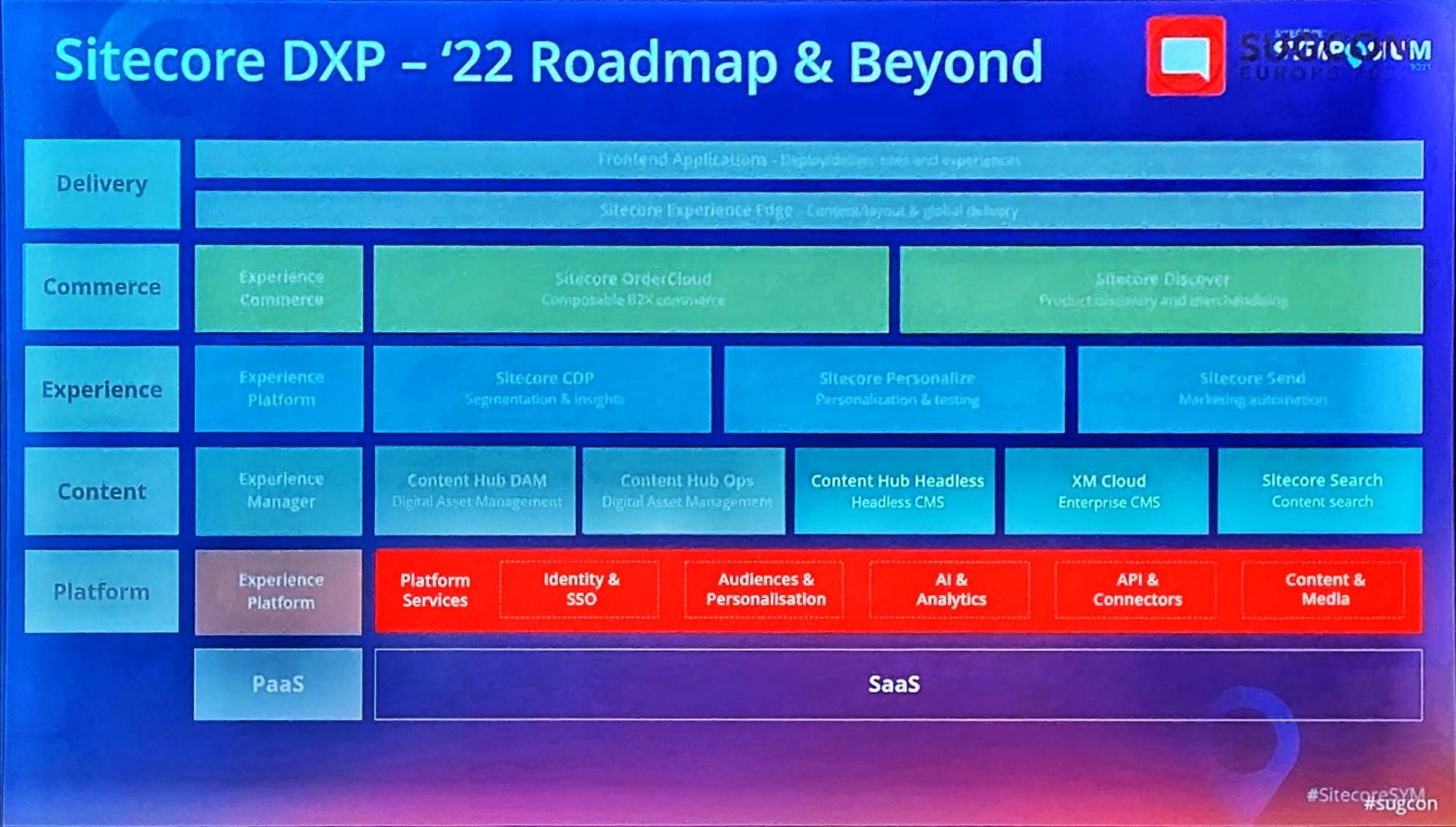
After, SUGCON 2020 EUR getting cancelled in the same city, after 2 years, the event was organized and conducted last month. A lot of new infos and details about their new product launches – XM Cloud/Content Hub headless and Sitecore Road Map 2022 was presented and talked about. Sharing them from twitter here so that it connects with whatever I’ve mentioned in the article so far.
Sitecore is expanding, increasing headcount, increased it’s spending on R&D. Adopted to better strategies. Poised to retain their position as Market Leaders.
With all these changes, plans and road maps, I believe Sitecore’s graph will move further up in the coming years.
* Years mentioned may have 6-12 months difference.
So, last week I read an article about Sitecore Upgradation by Martin Miles. In that article, at Upgrade Database step, it was mentioned that the default items in sitecore from 10.1 and above, are not stored in database and are read from file system.
10.1 was released almost a year ago and although I am working on a 10.1 instance I missed this information somehow. But it got me curious and I immediately checked the web root folder to see the file. The physical files are present under,
{webroot}/App_Data/items/core/items.core.dat
{webroot}/App_Data/items/master/items.master.dat
{webroot}/App_Data/items/web/items.web.dat
Prior to 10.1 there were no such folder called items under App_Data (Sitecore 10-App_Data folder below)
So, yes…..we have located the file. Now let’s open it and see the system defaults and get this over with and start my weekend!
But my stars had other plans it seems, When opened that dat file in notepad was surprised to see the defaults as below,
I missed the idea that it would have been encoded somehow. But I was not convinced yet, so to confirm that default items are not present in sql master db, I checked the database table itself.
Comparing it with a DB from 9.3
The few records which you see in 10.2 master database must be from my custom changes. Yes, the default items are not present in the database. But I’m still not convinced. I want to see the data inside items.master.dat file. So I explored deeper.
After some browsing, I was redirected to the Sitecore.config file.
Sitecore 10.2 Sitecore.config and……Voila!
The dataproviders and protobufitems are specified here.
When checked in Sitecore 10 sitecore.config no such values were specified.
Now there is this new terminology – Protobuf (well..at least for me it was). So as I said earlier, the sitecore default items are stored as dat physical file right, Protobuf is a google based serializer. So the default items are serialized using Protobuf and are shipped as file system.
So now, if we deserialize the dat file, we’ll be able to see the actual data. I started looking for various online protobuf serializers and to my luck, I didn’t find any. At the same time I was still curious and somehow wanted to see the data in the items.master.dat file.
So, I decided to see some .net code snippets for deserializing using protobuf package. So I came across this article, which made it pretty much straight forward. Read the file system, Serializer.Deserialize that’s it.
Created a simple .NET Console Application, Added the required nuget package,
When I actually wrote the code, the type <T>????
Then I remembered, that I had installed JustDecompile long back and based on the values specified in the sitecore.config – Database section – Sitecore.Data.DataProviders.CompositeDataProvider, Sitecore.Kernel; Sitecore.Data.DataProviders.ReadOnly.Protobuf.ProtobufDataProvider, Sitecore.Kernel; decided to decompile the kernel dll and see how they’ve handled it.
While loading these dlls, it asked for the dependency dll – Sitecore.Data.ResourceItems.ProtobufNet
After going through these dlls, realized that, the data is serialized as ItemsData using Protobuf. So to deserialize it, added this dlls reference to my application and …..
Now I’m convinced. 🙂
So, the reason for this change is that, it creates a separation between default items and our custom content changes thereby enabling upgradation process easier. Meaning, when we upgrade the sitecore instance, just these files have to be updated.
In one of my previous assignment, I was told, the load time of almost all the pages in the website is higher and was asked to analyze and improve the page load time.
That’s when I remember one of the Sitecore’s OOTB gem -> Sitecore Debugger. Sitecore debugger is available from very early versions – Sitecore 5, I guess (subject to correction). But to date, still there are several developers who are unaware of it’s feature hence this post.
Sitecore debugger when activated, loads the pages in debug mode. This debug mode, loads the page along with information about the load time of the page. By this I mean, it provides us information about the load time of each and every rendering in the page and more. As you know, sitecore renders the page via a pipeline of processors like item resolvers/layout resolvers etc, sitecore debugger provides the time taken by these actions as well.
Now coming back to the case study, When I opened one of the page in debug mode, I was shocked to see that the Header Navigation and Footer Navigation was taking almost 3/4th of the page load time. I was relieved as well. As now it makes sense why the load time of all the pages were high. And if I get to fix the load time of these two renderings then that it would solve the all the pages load time issue.
It was a multi lingual/multi site where the main navigation was rendered by reading all the contents under the content tree where a ‘include in header’ checkbox was enabled. The number items read to display header menu was more whereas the menu items displayed was less than 20. This information was provided in the Sitecore Profile session of the sitecore debugger. Finally, I fixed the performance issue by rewriting the logic. Instead of going through all the content in the content tree, based on the site definition, identified the site root path and processed only the content items under the site root path.
Sitecore debugger can be opened in two ways. One via Desktop Start Button in desktop (this opens the default site in debug mode from homepage)and second via Experience Editor->Debug Mode this opens the current item selected in the content tree.
Now going back to Sitecore Debugger, it provides two main stack of data about the page. Sitecore Profile and a more detailed report – Sitecore Trace. Sitecore Profile provides information about most time taken components – rendering under Hot Spots banner. It also provides high level information about the page. It gives info about Number of items read, Cache hits/misses etc
Sitecore Trace gives a more detailed stack information about the page load events and time taken for each steps. The total time taken along the time taken by individual events.
The profile/trace can be saved to a location in the Webroot or can be downloaded. It gives an XML version of the reported data.
I have already explored Unicorn and Sitecore Management Services for Sitecore Content Serialization purpose and written couple of articles about them. This is in continuation to that series.
(a small recap, to set the article context)
Prev. developers used TDS/Unicorn for content synchronization. TDS comes with license cost whereas Unicorn is open source. Although these two tools does the same functionality – Content Sync, the way in which they do that greatly differs. As TDS is a licensed tool, it comes with better UI and few additional features compared to Unicorn.
But these are all in the past. With Sitecore 10, sitecore introduced a new alternative to TDS/Unicorn which is Sitecore Content Serialization – a system for serializing, sharing, and deploying content items, as well as keeping them in version control.
SCS comes with two interface – Sitecore CLI(a PowerShell based approach) and Sitecore for Visual Studio(a TDS module).
We have seen about Sitecore CLI in prev. post. In this article, we’ll explore more about Sitecore for Visual Studio.
Sitecore for Visual Studio comes up with a per license cost of 399$. But thanks to their trail program, I was able to get a trial version for 30 days which I used for exploring SVS. The link for free TDS Trial. You can only use your official mail id – your organization’s mail ID to get the license key. The license key will be sent to your mail id.
You can download the SVS plugin from this link. The latest version, Sitecore for Visual Studio 4.1.0.0 requires, Visual Studio Community 2019 17 and above. Unfortunately, my local version is not updated to that version yet so I am using SVS 1.0.0.9 for this demo.
Once downloaded, unzip->install the SVS VS Plugin.
After installation, when you open your VS Solution, you’ll be presented with the License Agreement, accept them. Post that you’ll be redirected to the License Manager Dialog. Enter you license details and proceed.
After entering the license details, you can open the Sitecore Module Explorer from View->Other Windows->Sitecore Module Explorer.
I have two module.json file in my solution, SVS automatically detects the module.json files and shows them here. (You can add module,included and rules right clicking Modules->New Module. Enter the module details like namespace etc. Right Click on the module to add includes.)
You can pull the changes from Sitecore to Disk by right clicking on the module.
We can check-in the changes and in the target environment we can do the ser push which will move the synced yml changes to sitecore content tree.
Watch
With watch enabled, whenever we make a change to an item in the content tree, sitecore automatically serializes that item to disk.
For eg. The existing value of a field in my home item is,
After changing,
Without doing any pull as watch is enabled,
To conclude, Sitecore CLI and Sitecore for Visual Studio are not entirely two different tools. They are just two different ways of doing the same process. Both same components in the background. Advantage is SVS gives a friendly UI. We can add or remove modules, set module scope/add rules easily. But this comes with a 399$ license cost.(Including TDS).
So, you must have probably used Sitecore Personalization using rules. You must have added some rules to your rendering to provide more personalized content to your visitor based on some conditions. When these conditions are met, the rules are triggered by the rule engine and the content is updated.
Sitecore Optimization – A/B Testing:
You must have setup Sitecore A/B testing or Multi Variate testing on your web page to get better insights on which content to be used so that it drives more value to your site. This helps content authors in creating the best content for your web page that has the best possibility of driving more values to your site on each user visit.
Sitecore Path Analyzer:
You must have used Sitecore Path Analyzer to know about the most efficient and least efficient paths that a visitor takes while accessing your site. You must have used to identify the path taken by the user from landing page to any of your product page. Once you the insights you can position the page in nth level of navigation accordingly.
Profile/Pattern Cards:
You must have created Profile Keys, Pattern Cards and Profile Cards to profile your visitor based on their online behavior and then assign them a profile/pattern and identify the best pattern match. You finally use this to get better customer insights and finally provide better customer experience.
All these are some of the Sitecore’s Marketing Application modules and some of use may have used them regularly. I always wondered how did they come up with the idea of these applications. We have seen the final product, I wanted to get some insights – tiny behind the screen peep. To understand them from raw requirement perspective. And did came across some interesting articles. Got the patent details pertaining to these modules owned by Sitecore. Sharing these info here hoping you find it interesting as me.
US Patent for Webpage comprising a rules engine Patent (Patent # 9,679,073 issued June 13, 2017) – https://patents.justia.com/patent/9679073 – Base for Sitecore Personalization using Rules.
US Patent for Method and a system for analysing impact of changes to content of a website Patent (Patent # 9,292,615 issued March 22, 2016) – https://patents.justia.com/patent/9292615 – Base for A/B Testing and et all
US Patent for Method and a system for analysing traffic on a website by means of path analysis Patent (Patent # 9,524,511 issued December 20, 2016) – https://patents.justia.com/patent/9524511 – Base for Sitecore Path Analyzer.
US Patent for Method and a system for managing a website using profile key patterns Patent (Patent # 9,003,015 issued April 7, 2015) – https://patents.justia.com/patent/9003015 – Base for Sitecore Profile Keys, Profile/Pattern Cards.
Other patents owned by Sitecore are available in the mentioned portal. Portal also shares information about other patents owned by Salesforce, Apple, Tesla etc









 Sitecore Blog